
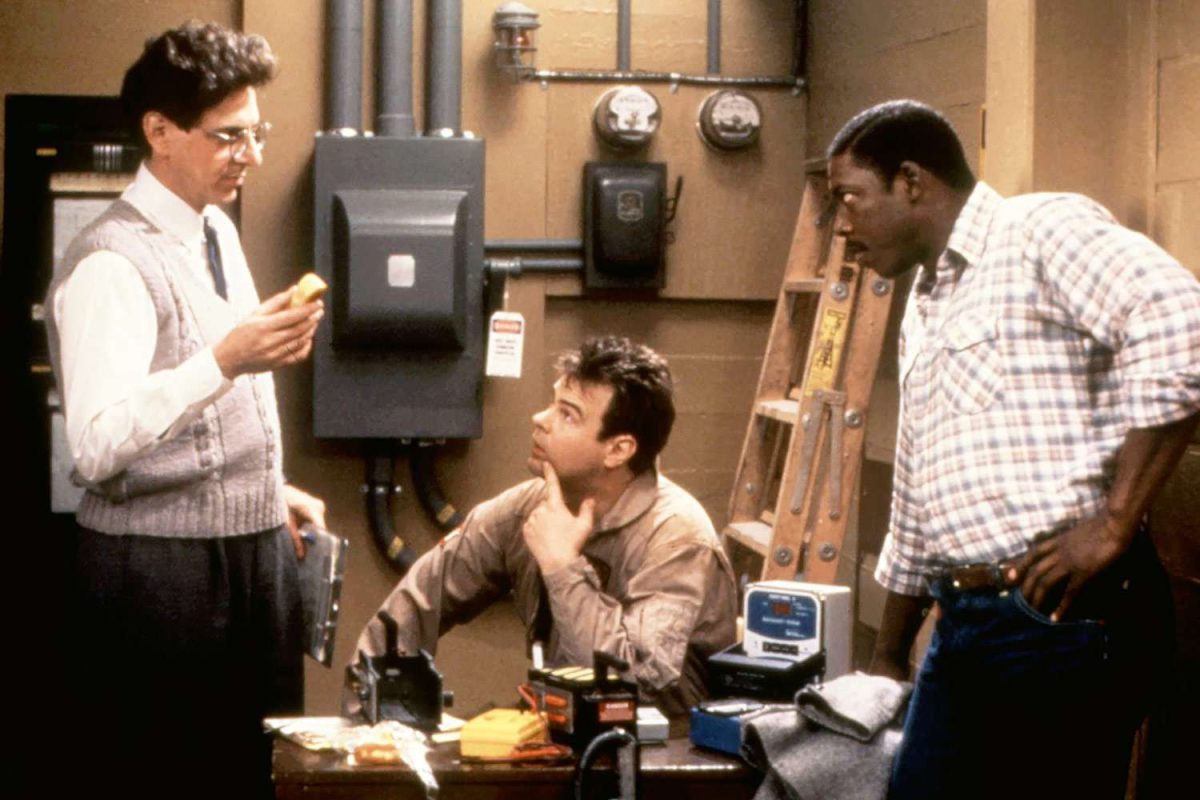
Most film enthusiasts, “Ghostbusters” fans, and anyone who has seen a Harold Ramis comedy think of Bill Murray as Harold Ramis’ most important professional relationship. The pair worked on six films together and made comedy history with classics like “Caddyshack,” “Stripes,” “Groundhog Day” and (of course) the “Ghostbusters” franchise.
However, the professional relationship between Ernie Hudson and the late Ramis was a sweet, honest, and mutually respectful companionship. Out of the “Ghostbusters” cast, Ernie Hudson has arguably been the most outspoken on Ramis’ lasting impact since his passing. The entire cast and crew have made statements, but it’s Hudson who continues to praise Ramis at every opportunity.
Many Ghostbusters fans are aware that the four Ghostbusters were each assigned an “archetype” by writers Dan Aykroyd and Harold Ramis. Peter Venkman (Murray) was “The Mouth,” Ray Stantz (Aykroyd) was “The Heart,” Egon Spengler (Ramis) was “The Brain” and Winston Zeddemore (Hudson) was “The Everyman.”
But in real life, Ramis seemed to fit “the heart” title better. Hudson has credited Ramis as the “glue that held it all together” regarding the often messy, tumultuous set of “Ghostbusters.”
During a Q&A at Galaxy Con in 2024, Hudson said he believes that we wouldn’t have Ghostbusters without Ramis. He was a grounded presence among the obvious chaos (if you know anything about the making of the film).
“Everyone trusted Harold,” Hudson says. “[He] was the guy who everyone respected enough to look past their own stuff.” Hudson went on to explain that Ramis, being a “voice of reason,” helped change Hudson’s perspective on how to handle the toughest parts of being in Hollywood, which Hudson was struggling with on the set of “Ghostbusters.”
Hudson was frustrated with script changes and felt like an outcast among the cast and crew (many of whom had worked together previously). He also notes that Murray could be an unpredictable personality on set that caused frustration among the crew.
At the Austin Film Festival in 2005, Hudson and Ramis (humbly) explained that many Zeddemore lines were shifted and given to Murray. During production, Hudson (rightfully so) believed he was being racially discriminated against. Hudson openly praised Ramis’ camaraderie and mentorship, which allowed Hudson to follow Ramis’ calm and level-headed example and encouraged him to continue on production.
Hudson realized he could never be sure of people’s true intentions, but he could only control his response. He wanted to give the film the best he could, and he appreciated Harold Ramis’ allyship. In the end, his character Zeddemore gave us iconic lines like “That’s a Big Twinkie,” “If there’s a steady paycheck in it, I’ll believe anything you say,” and the closing line of the film, “I LOVE THIS TOWN!”
Hudson and Ramis worked together again for “Ghostbusters II” and the lesser-known comedy “Airheads” (1994) as Officer O’Malley and Chris Moore.
[If Harold Ramis saying Brendan Fraser and Steve Buscemi are “the hottest thing since Marky Mark and the Funky Bunch” piques your interest, you can view the scene HERE!]
There was an undeniable mutual respect between these two men. There was friendship, admiration, and appreciation there. You can hear it in the 2005 Q&A when Ramis admires how tactfully Hudson speaks about the drastic script changes despite the frustration. Likewise, Hudson pats Ramis on the back.
Hudson also attended the after-party for Ramis’ final film, Year One, in 2009 (see cover photo).
The Loss of Harold Ramis
Harold Ramis, Dan Aykroyd, and Ernie Hudson all expressed interest in doing a Ghostbusters 3 (besides the 2009 Video Game that Aykroyd referred to as the third movie), which was being written and developed by Ramis and Aykroyd. Fans were anticipating a return of the four iconic men in uniform. However, Harold Ramis passed away on Feb. 24, 2014, leaving the future of “Ghostbusters” unknown. Everyone knew there was no “Ghostbusters” without him.
For Hudson, there’s no doubt he misses Ramis. While I’ve read many official statements from celebrities that poured in after Ramis’ death, there is one TMZ video that stands out. Hudson is exiting an airport, while stating he just learned of Ramis’ passing. Still, he praises him, saying, “I owe him everything,” and that a new Ghostbusters movie couldn’t be made without him.
Once again, Hudson’s admiration and respect for Ramis are evident.
After the poor reviews of Paul Feig’s “Ghostbusters” (2016), many wondered if anything could touch the heart and charm of the originals. There are many arguments why the film “didn’t work,” but I believe the film had a core issue that was deeper than poor writing or plot choices. It had to do with legacy.
The legacy of Ramis, to be precise.
Fans were waiting for the third movie, and anticipation was high. The idea of seeing all four Ghostbusters suited up again would invoke joy and nostalgia in generations of fans and casual watchers. Yet, without Ramis, our writer, our Egon Spengler, would it ever be the same? How could we acknowledge the “glue that held it all together?” It needed to be done, somehow.
I feel that the 2016 film did a poor job at executing this acknowledgement. EvenHudson expressed that he didn’t want fans to think they were ignoring the loss of Ramis. The film shows an admittedly beautiful bust statue of the late Ramis, but it’s hidden in the background of a “blink, and you’ll miss it” moment. The statue now resides at Harry Caray’s Tavern on Navy Pier and is taken out every Groundhog Day on the annual Harold Ramis Day celebration; a far better use of the statue, in my opinion.
There is supposedly a dedication credit to Ramis at the end of the film as well. But truthfully, you have to know where to look.
The friendships that Ramis had with the cast and crew of Ghostbusters are not evident in this film at all, and the character of Egon Spengler (as well as all of the original Ghostbusters) is absent. I believe this lapse in acknowledgement and proper tribute to Ramis, especially only two years after his death, was unsatisfying to some audiences and left an emptiness in fans.
More importantly, there was no closure.
Not for audiences, or the cast and crew of the original.
Enter “Ghostbusters: Afterlife” (2021) (SPOILERS)
Assuming that you have seen this film, the last ten minutes of this film are powerful, moving, gut-wrenching, bittersweet, and every other emotional word you can think of. Thanks to the permission of the Ramis family, we got to see this gift. Seeing the ghost of Egon Spengler invokes so many emotions in the viewer; it’s heartbreaking yet heartwarming all at once. You can’t look away because you can’t believe they pulled it off.
More importantly, seeing him beside Hudson, Aykroyd, and Murray is extremely meta. One doesn’t need to know the truth of Harold Ramis’ relationships with these men or understand the things he left behind unfinished to feel the emotions, but for those who do know, it’s incredibly poignant.
Yet, it’s Hudson’s performance that always gets me.
Winston (Hudson) is the first to acknowledge Spengler. He maintains this bewildered look, both confused and maybe even amazed. But this expression grows to something softer, warmer.
Winston continues to look at Egon even as Phoebe (McKenna Grace) runs off, while it takes Peter (Murray) and Ray (Aykroyd) a few moments to acknowledge the spirit of their friend.
It’s then that Winston says, “I should’ve called. I miss you, my friend.”
This line is the only one delivered by the other three Ghostbusters that acknowledges the ghost as a tribute to a life and friendship, not a plot point for the ending of a narrative. The other dialogue may not necessarily make sense outside the plot of the story, but it’s Hudson’s line that recognizes the real-life implications of this vision of Ramis.
Hudson speaks it softly, almost as though it’s a promise. It comes from the heart.
The ghost smiles and nods his head, in the warm Ramis fashion, somehow replicated beautifully with computer animation. While the concept of “bringing actors back to life” with CGI is controversial, I believe this is one of the very few done right.
I believe the context of Ramis’ friendship with Hudson adds a layer of tenderness to a scene already destined to make you cry.
Furthermore, being knowledgeable about the context of Ramis’ career and relationships with his family and friends, like his daughter Violet Ramis Stiel, or Ivan and Jason Reitman, makes the scene feel very personal and carefully crafted. It is a very thought-out sequence.